
| SECTION 3.3 OF 8 | [1] [2] [3.1] [3.2] [3.3] [4] [5] [6] [7] [Ap] | DOWNLOAD PDF |
R L Gregory and J G Wallace
Reproduced from Experimental Psychology Society Monograph No. 2 1963
(4) The Patient's First Drawings
We asked S.B., on the same day that the visual tests already described were administered, whether he would try to draw for us. He said that he had not so far tried to draw, though he had tried to write, and indeed he produced a laboured but just legible version of his own name, which he produced with great pride. (His wife had recently given him a ball point pen - his first writing instrument - and he had written his name to show to Mr. Hirtenstein.)
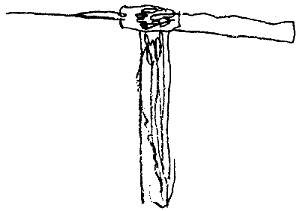
Fig. 9. The Patient's First Drawing: This drawing of a cobbler's chipping hammer was made in our presence on the 48th day after the first operation.
(A) A Hammer (Fig. 9) was a subject of his own choosing - a cobbler's chipping hammer. This seems to be the first drawing that he ever made. He was most doubtful of his ability to draw, but once started, he enjoyed it, and attacked it with great concentration. He placed his head very close to the paper, using only his preferred (right) eye, and checking the results from time to time holding the paper further away.
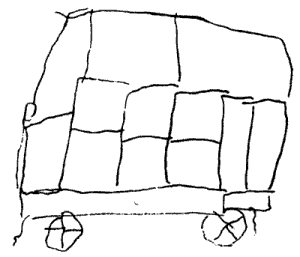
Fig. 10. Drawing of a Bus (48 days after the first operation).
(B) A Bus (Fig. 10). This was a subject which we suggested to him - a bus. We chose it because he was familiar with buses as a blind man, and all transport interested him. We also had some evidence that at first buses seemed to him too tall, though of the correct length, and this seemed a matter of some interest. He had seen several buses since his operation - also cars and lorries - and it was clear that he thought this an interesting task.
He expressed dissatisfaction with his drawing because he found himself quite unable to draw the bonnet, or radiator. This is striking for it would be the principal part that he would not have touched to any great extent when blind. The rather exaggerated windows might well represent the tactual conception of them, perhaps as felt from the inside. The wheels, it may be noted, are shown as having spokes. We questioned him on this and he replied that he knew that buses had hub wheels, but that he was more familiar with the feel of cart wheels. Evidently the more striking tactile impression would be of a wheel having spokes, and this seemed to mean "wheel" for him. He also said that he did not know how to draw a hub wheel, without spokes, so he "made them simply like cart wheels". He said that he knew the shape of hubs quite well, for he often washed his brother-in-law's car, and then he tried to picture it as it seems by sight. He drew buses later (Fig. 14a and b) and these we discuss below.
When he had drawn the bus and had discussed it, we left him to choose his own subject.
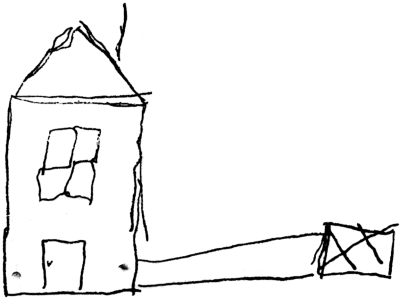
Fig. 11. Drawing of Farm House.
(C) A Farm House (Fig. 11). He said that this was meant to be the gable end of a farm house, with a path leading up to the house from a gate. It represented his idea of the Archers' House in the radio serial, to which he listened regularly.
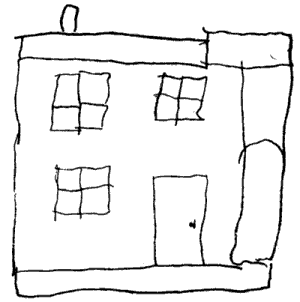
Fig. 12. Patient's Drawing of his Own House.
(D) S.B.'s House (Fig. 12). This was his own choice. The archway at the right hand side represents the entry to a passage round the side to the back of the house. He was worried by his inability to represent the pavement.
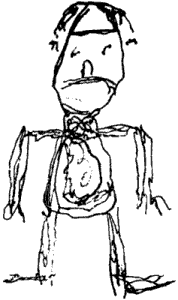
Fig. 13. Drawing of a Man. (48 days after the first operation).
(5) A Man (Fig. 13). (No man in particular). He first drew the head, spending a long time on the mouth. We asked him to add the body, so any distortion of scale between the head and body should not be taken as important. When he had finished the body he said "I'm afraid I forgot to put him any knees".
(5) Discussion on S.B.'s Drawings
It is well known that some blind people are capable of drawing objects familiar to them by touch. [ Footnote 11. ] Typically, the characteristic tactile features appear to us exaggerated and perhaps they can give us some information as to how objects appear to the blind. It is interesting that S.B.'s early drawings are all typical of drawings of the blind. He introduces no features which he had not known previously by touch, although at that time (48 days after the first operation) he could name these objects confidently from vision alone. Thus although he could use vision to recognise objects he seemed incapable of recalling the specifically visual information and to represent it in his drawings.
The hammer, (his first drawing) was quite certainly drawn from touch memory as he had never seen it. The first drawing of a bus (Fig. 10) is revealing in showing importation of a characteristic tactile feature which was not in fact present in the buses he saw in the period after the operation: the spokes of the wheels. The buses he had seen had disc wheels, but to him a wheel characteristically has spokes and he imported these and added them to his bus, which he drew, as with the other drawings, sitting in the hospital room without having the object present to draw from.
The farm house (Fig. 11) represents his imagined house in a radio serial (the Archers) and incorporates only features known to him by touch. It may be noticed that the window is identical with drawings of the windows of this own house (Fig. 12). It may seem surprising that he should have a touch image of an object as large as a house, but in fact he painted his own house, using a ladder, and feeling the brush along the woodwork, which he did fairly competently. It may be noted that the roof is ambiguously represented.
He took longer to draw the man (Fig. 13) finding it difficult, and was dissatisfied with the result. Blind people like exploring other people's faces with their fingers, and at that time he knew that his previous conception of faces was highly inadequate, but his vision did not serve to give him recognition of individuals from their faces or of the significance of facial expression. He seemed to have a feeling of inadequacy and disappointment over this. After doing this drawing he looked worried and apparently could make little of his own drawing. He ended by saying: "I'm afraid I forgot to put him any knees", and relinquished it with a sigh.
(6) Addendum: Later Drawings
 |
 |
| (a) | (b) |
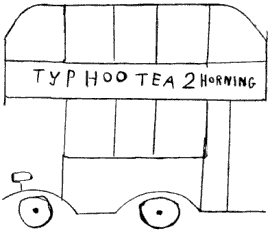
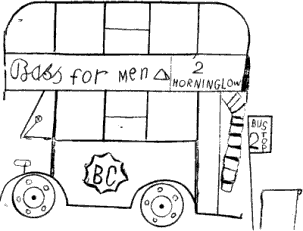
Fig. 14. Drawings of a Bus. (a) 6 months later; (b) one year later.
The later drawings of a bus (Figs. 14a and b) were done six months and a year later respectively. They give some indication of the patient's increasing ability to use specifically visual information. There are several points of interest. In all cases the radiator is omitted, and this would not have been known by touch as the front of a bus is a position of danger to a blind man. The mirror is shown in all three drawings and mirrors always fascinated him. One suspects that he is representing the windows as he knew them by touch from the inside. The spokes, imported from touch in the first drawing, are absent in the second and a much more sophisticated version of the wheels is given in the third. There is no writing present in the first drawing. This appears in the second but is only upper case lettering, which he already knew by touch, while in the third drawing lower case lettering is beginning to appear: this he learned only after he gained his sight.
Finally, it will be noticed that in all three cases the buses are shown in profile and facing to the left. As a blind man he would only touch buses when they presented this aspect to him (since traffic is on the left hand side of the road in this country), and he retains this aspect even in the last drawing.
These drawings illustrate the general finding that although S.B. came to use vision, his ideas of the world arose from touch and his general way of life as a blind man remained with him until his death.
continues with Section 4 Observations after discharge


