
| FOREWORD AND PREFACE | BACK TO CONTENTS | DOWNLOAD PDF |
R L Gregory and J G Wallace
Reproduced from Experimental Psychology Society Monograph No. 2 1963
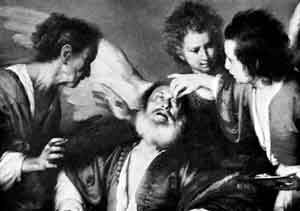
Tobias cures his father's blindness - Bernardo Strozzi 1581 - 1644
Foreword
Although it is nearly 300 years since Molyneux posed his celebrated query, interest in the problem of recovery of vision after early and long-standing blindness is of comparatively recent origin. In 1932, Dr. M. von Senden carefully reviewed the literature on the perception of space and shape in the congenitally blind before and after operation and arrived at some important conclusions. In particular, he stressed the slow, laborious and imperfect way in which the perception of form is acquired by these patients and their liability to emotional "crises" as they come to discover the true extent of their disability as sighted persons. Unfortunately, Dr. von Senden's monograph remained little known to psychologists, at all events in this country, and it was not until 1949, when Dr. Donald Hebb published his fascinating book on The Organisation of Behavior, that its significance came to be at all widely appreciated. As every psychologist knows, Dr. Hebb placed considerable weight on Herr von Senden's evidence and believed it to throw important light on the nature of visual perception and its development in infancy. Although there is disagreement regarding the interpretation of this evidence, there can be no doubt as to the fresh and stimulating influence which Dr. Hebb's ideas have had upon contemporary psychological thought.
One of the main obstacles to informed discussion of Dr. Hebb's theories has been the inaccessibility of the clinical evidence. This, it is true, has been remedied to some extent by the publication, in 1960, of an English translation of Dr. von Senden's monograph but even so the position is far from satisfactory. It was never the author's intention to assemble detailed case reports and it is not always easy to distinguish between the facts as recorded by others and the interpretation which Dr. von Senden has placed upon them. If for only this reason, the addition of a fresh and well-studied case to the widely dispersed literature will be warmly welcomed.
The authors of this monograph have provided a full description of the history and progress of a man, effectively blind almost from birth, who underwent two operations for corneal grafting at the age of 52, as a result of which he recovered appreciable sight. As they relate, their attention was first drawn to the case by a newspaper report and it is to their great credit that they followed the matter up. With characteristic enterprise, Mr. Richard Gregory made an approach to the Ophthalmic Surgeon in charge of the case, A. Hirtenstein, Esq., F.R.C.S., of the Wolverhampton and Midland Counties Eye Infirmary, who responded with warm friendliness and generosity. Indeed it is entirely due to his kind permission to study the case and to his encouragement throughout that the work reported in this monograph could be undertaken.
This case study will be of interest to many. To the psychologist, perhaps the most arresting finding is the extent of "transfer" of information from touch to vision which the authors have been able to demonstrate. They point out, too, that much of their patient's difficulty in visual learning can be ascribed to his long-standing reliance on touch and the whole complex of well-engrained habits to which it had given rise. This leads them, in my view rightly, to suggest that great caution should be exercised in drawing parallels between the recovery of vision after operation in adults and the normal development of perception in young children.
The authors would be the last to claim any particular expertise in clinical inquiry. Nevertheless, readers will be impressed by their resourcefulness and determination to proceed wherever possible by the method of experiment. In spite of limited experience, they carried their study through in a manner entitled to warm admiration and respect. Although it is always risky to generalise from a single case, their work undoubtedly serves to throw light on important issues in the development of perception and the cross-modal "transfer" of information. They have presented their case with modesty, skill and warm humanity.
O. L. ZANGWILL.
Preface
We would like particularly to thank Mr. A. Hirtenstein, F.R.C.S.,the ophthalmic surgeon under whose care the patient was admitted to the Wolverhampton and Midland Counties Eye Infirmary, for his kind permission to study and investigate the case and for his most helpful advice and criticism. Without his co-operation and help this study would not have been undertaken. The staff of the hospital were most helpful, in particular the Matron, Miss Mary Jones.
Through the generosity of the Daily Express, we were able to study the patient for several days immediately after his discharge from hospital. Mr. Merrick Winn, the writer, was most helpful with his insightful comments and suggestions.
We would like to thank the patient's wife for her help and comments on many aspects of her husband's life before and after the operation. His sister also provided vital evidence as to his early vision. The Birmingham Royal Institution for the Blind have kindly given permission to publish the case records covering the period the patient attended the Institution.
We are sincerely grateful to Mr. Hirtenstein and Herr M. von Senden for their kind permission to publish correspondence bearing on this case.
Professor D. O. Hebb kindly read the manuscript in draft and we are grateful to him for many valuable comments. It should be said, however, that we alone are responsible for the interpretation placed upon the case. Since completing our study, we have gained much from discussion with Dr. B. R. Gomulicki.
We would especially like to thank Miss Kathleen Watts for her help in preparing the manuscript for the press.
Professor O. L. Zangwill gave most helpful advice and encouragement during the investigation and in the writing of this monograph. We are much indebted to him.
The patient was studied by us jointly, much of the detailed testing being carried out by the junior author. We were both present on all occasions, so that all the observations reported in this monograph have been confirmed by at least two witnesses. The actual writing from our combined notes, is the responsibility of the senior author. One of us (J.G.W.) was supported by a grant from the Medical Research Council, who also kindly provided a small grant for expenses. We gladly acknowledge their assistance.
We wish to thank the publishers, D. van Nostrand Company, Inc., for permission to reproduce Figure 8 from Beardslee and Wertheiner's Readings in Perception, Copyright 1958, D. Van Nostrand Company, Inc., Princeton, N.J.
R.L.G.
J.G.W.
To Contents


