
| PAGE 1 OF 3 | [1] [2] [3] | DOWNLOAD PDF |
R. L Gregory
From Concepts and Mechanisms of Perception (1974, London: Duckworth) pp. 501-518 and Nature, 203, 4942, 274-295 with the kind permission of the Editor.
[The story behind this idea is, perhaps, of interest in showing how a question can suggest another more interesting question, leading with luck to something unexpected. The question concerned stereoscopic vision, but it led by three or four steps and a few minutes of thought in a darkroom, to the possibility of something quite different - a telescope camera for getting improved pictures of the moon, the planets and the stars. My father, C. C. L. Gregory, was a professional astronomer, and I had been brought up with telescopes and so with the problem of 'seeing' - the problem of the disturbance of telescopic images by atmospheric turbulence. This is beautifully described by Newton (Opticks, 1704) who was pessimistic about any cure. Indeed he said that a cure was simply impossible. But even Newton was not always right in his strictures: he declared that chromatic fringes would for ever beset images given by lenses; not at all foreseeing the invention of achromatic combinations of flint and crown glass lenses (generally attributed to John Dollond; suggested by Chester Moor Hall in 1729 and demonstrated by Samuel Klingen-Steirna in 1758). Newton describes the problem, and the supposed impossibility of cure, in the following passage in Opticks:
If the Theory of making Telescopes could at length be fully brought into Practice, yet there would be certain Bounds beyond which Telescopes could not perform. For the Air through which we look upon the Stars, is in a perpetual Tremor; as may be seen by the tremulous Motion of Shadows cast from high Towers, and by the twinkling of the fix'd Stars. But these Stars do not twinkle when viewed through Telescopes which have large apertures. For the Rays of Light which pass through divers parts of the aperture, tremble each of them apart, and by means of their various and sometimes contrary Tremors, fall at one and the same time upon different points in the bottom of the Eye, and their trembling Motions are too quick and confused to be perceived severally. And all these illuminated Points constitute one broad lucid Point, composed of those many trembling Points confusedly and insensibly mixed with one another by very short and swift Tremors, and thereby cause the Star to appear broader than it is, and without any trembling of the whole. Long Telescopes may cause Objects to appear brighter and larger than short ones can do, but they cannot be so formed as to take away that confusion of the Rays which arises from the Tremors of the Atmosphere. The only Remedy is a most serene and quiet Air, such as may perhaps be found on the tops of the highest Mountains above the grosser Clouds.
The insights of genius can blind later generations. Sometimes, we must turn away to see afresh. It is possible that this passage, no doubt read by students of optics ever since it was written, helped to inhibit seeing this as a problem to be considered.
I was led to a possible solution, before realizing there was a problem that might be solved. It was a very different question which led to this: the question 'Does the brain reject most of the information from retinal images when "computing" depth from disparity differences between corresponding points from the two eyes?'
This suggested the experimental question: 'What would a picture of the difference between stereo pairs look like?' To answer this, I made a photographic pair, and printed one as a positive and the other as a negative transparency. It was a simple matter, in the darkroom, to make a 'sandwich' of these, and place the sandwich pair of photographs in the enlarger. If the pictures were identical - but one a positive and the other a negative - then they should cancel each other. Virtually no light should get through. Any discrepancy (such as generated by stereoscopic disparities) should allow light to pass. The result should be a difference picture, in which only the discrepancies would appear. This worked much as expected. Large areas cancelled themselves out, and outlines representing stereo differences remained. It was while adjusting the negative/positive sandwich in the enlarger that I noticed the effect that suggested the possibility of automatically rejecting disturbances. When the photographic sandwich was most closely registered, the total light falling upon the enlarger easel was markedly less than when they were misplaced. When the negative registered most closely with the positive, cancellation was greatest, so the least amount of light got through the sandwich to the enlarger easel. It seemed clear that one might make a device for automatically matching something with its own negative. 'But,' I then thought 'suppose it is not a "thing" but an image - a fluctuating image - which is matched against itself.' If (and this was the crucial point) a photograph of an object was taken through the turbulence of the atmosphere - then surely the disturbance could be rejected. Surely telescopic pictures could be improved. It would be necessary to take a long exposure photograph of the object (the moon) through the disturbance; project the image of the moon through its own photographic negative, then detect the amount of light getting through the negative. When the light was most occluded, the image would be most highly correlated with its average self. In these moments its disturbance must be least - so if a second photograph were built up during these moments, this second, sampled photograph should be less disturbed than the original photograph. Having arrived at that point, I began to have such doubts that I almost rejected it out of hand. The thought: 'Wouldn't it be pulling oneself up by one's own shoe laces?' dominated, and almost killed the idea stone dead as it was born. But a few minutes more in the silent darkness convinced me that this would not be pulling one's self up by one's own shoe laces: for the object was continuously available for supplying more information. This chain of thought took perhaps twenty minutes. I rushed out of the darkroom in great excitement, and more or less collided with my Professor's wife. I explained that I had a great idea, and would she like to look at a demonstration? She looked at me sadly, and went on her way.
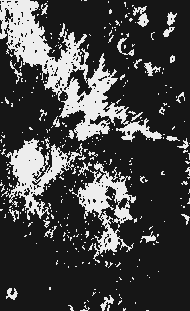
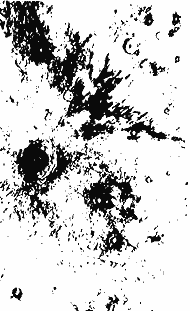
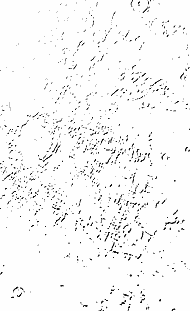
What happens is most clearly seen by making a negative/positive sandwich, and observing the changing difference picture with varying displacements. Local discrepancies can be introduced by deforming the 'sandwich' slightly with pressure from a finger. Fig. 1 shows a negative and its corresponding positive, and a difference picture obtained from this pair, showing partial cancellation. One may think of this dynamically to visualize the working of the sampling camera striving to defeat the confounding ever-changing air.
 |
 |
 |
| (a) | (b) | (c) |
FIG. 1 A negative/positive pair of photographs and a difference picture. (a) is a positive, (b) the corresponding negative, and (c) is a difference picture. The positive (representing the image) and the negative (representing the Master Negative in the camera) are placed in contact to form a 'sandwich', which is opaque where the positive and negative coincide - as happens when the image features are undisturbed.
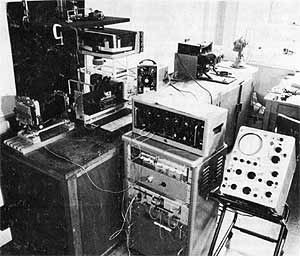
FIG. 2 First bench test apparatus to test the idea of running cross-correlation sampling, for improving telescope images.
We collected all sorts of bits and pieces (including my gramophone amplifier) to set up a bench test experiment to try the idea out. (Fig. 2). So far as possible we used available equipment, but we had to make a 'sampling shutter', capable of operating on demand from electrical pulses, given by mismatch signals from the photo-cell behind the Master Negative. Bill Matthews and I built the first sampling shutter (later improved by Stephen Salter) using a pair of electro-magnetic vibrator units. These were mounted opposed to each other, carrying thin squares of metal, each a half-square. When drawn apart a square hole was revealed, allowing light to pass; when drawn together the hole closed, preventing light reaching the second camera during sampling. This shutter is shown in Fig. 3.
We built this first apparatus in six weeks. It worked! For slowly oscillating images (moved with an oscillating Perspex plate in the light path) or later with random disturbance given by an agitated water bath, which proved a good simulator of atmospheric disturbance, we obtained very noticeable improvement with the sampling technique.
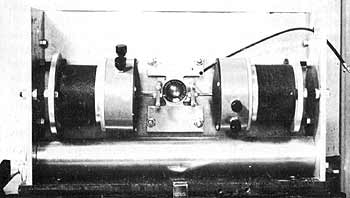
FIG. 3 First sampling shutter. This consists of a pair of electro-magnetic actuators (at right and left) which draw apart a pair of half squares (hidden behind front element of lens), when a close match between image and negative is signalled from photocell.
The following brief paper, which appeared in Nature, first described the idea, and the initial bench tests with the first crude apparatus. This led to our getting support, and help from many people, allowing us to build and test an instrument suitable for trials on telescopes. Would it - will it - reveal new secrets?]
continues

