
| PAGE 1 OF 3 | [1] [2] [3] | DOWNLOAD PDF |
Richard L Gregory, Priscilla Heard
From: Perception, 1979, volume 8, pages 365-380 with the kind permission of the Editor
Brain and Perception Laboratory, University of Bristol, Department of Anatomy. The Medical School. University Walk, Bristol BS8 1TD. England
Abstract
The Cafe Wall illusion (seen on the tiles of a local café) is a Münsterberg chequerboard figure, but with horizontal parallel lines which may have any luminance separating the rows of displaced squares. These (these 'mortar' lines) display marked wedge distortion which is especially affected by: contrast of the squares ('tiles'; width of the 'mortar' lines, and their luminance which must not be significantly higher than that of the light squares or lower than that of the dark squares for distortion to occur. An experiment is described from which quantitative data have been obtained by varying these parameters. It is suggested that contiguous regions of different luminance (and contiguous colour regions) are normally held in spatial register by locking from common luminance boundaries. The Café Wall illusion is attributed to this border locking producing inappropriate contour shifts from neighbouring regions of contrasting luminance when separated by narrow gaps of neutral luminance. Further implications on the border-locking notion are discussed.
1 Introduction
1 .1 Background
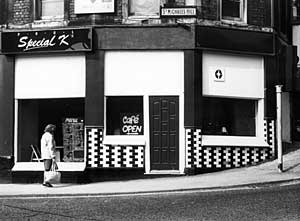
Figure 1. The original of the Café Wall, St Michael's Hill, Bristol.
It was noted some time ago (Gregory 1973) by a then member of our laboratory, Steve Simpson, that the mortar lines of the chessboard-like design of tiles of a café wall in St Michael's Hill, near our laboratory in Bristol, appear not parallel as they are, but to converge markedly in alternate-direction wedges (figure 1). We made models of similar patterns in which several parameters could be controlled, especially luminance contrast of the 'tiles', colour of the 'tiles', and their rectilinear proportions; and the width, the colour and the luminance of the parallel 'mortar' lines. Hundreds of subjects were shown these models, mainly in the informal setting of lecture demonstrations, while we got a feel for the phenomena which were striking and remarkably consistent. It was at once noted that most of the effects persisted, or changed in repeatable, consistent ways, over a very wide range of viewing conditions. So there were clearly 'hard' data to be extracted. The basic figure of a chessboard with alternate rows of squares shifted by half a cycle is the Münsterberg figure (figure 2).
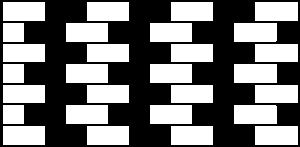
Figure 2. The Münsterberg figure.
By our term 'Café Wall' illusion we refer to the much more general case, especially where the 'mortar' lines may have a luminance different from either the light or dark 'tiles'. It turns out that the parallel black lines of the Münsterberg figure, in which the dark squares ('tiles') are also black, is a special and limiting case; it does not reveal several features of interest in this unusual distortion illusion, in which all lines are parallel or at right angles, and the figure is essentially symmetrical though the evoked distortion is markedly asymmetrical.
From these informal though rather extensive observations by many observers several 'laws' emerged.
1.2 'Laws' of the Café Wall illusion
(i) The alternate wedge distortions occur in the same directions, at all times, for all observers under the same viewing conditions; and for all observers the wedge distortions reverse when alternate rows of tiles are pushed across half a cycle.
(ii) The distortion remains in the same direction for a wide range of shift of the alternate rows: there is no sudden switch of wedge direction when alternate rows are shifted across the bisection, as might have been expected.
(iii) Neither the amount of the distortion nor the direction of the distortion wedges depend on how the sides of the display are masked. So it is not due to any kind of end effect of the sequence of dark and light tiles at the sides. The wedge distortions are therefore given by the repeated small scale asymmetrical features of the figure. (iv) The distortion is much the same for any orientation of the figure. Moulden and Renshaw (1979) find, however, small changes with the Münsterberg figure.
(v) The rectangles can have a wide range of vertical-to-horizontal length ratios. [For experiments described in this paper we have used approximate squares.]
(vi) The distortion is highly dependent on the luminance contrast of the tiles: it increases with increased luminance contrast.
(vii) The distortion occurs only when the luminance of the mortar lies between the luminances of the dark and light tiles, or at least, the mortar is not much darker than the dark or lighter than the light tiles (figure 3). The standard Münsterberg figure is a limiting and nonoptimal case where the luminances of the mortar and dark tiles are the same. The importance of what we call mortar luminance was realised by Fraser (1908).
(viii) The illusion is retained with coloured tiles (say red and green) and coloured mortar; but not when the contrasting coloured tiles have the same luminance. This dependence on luminance contrast, and loss of distortion at isoluminance was appreciated by Fraser (1908); and confirmed by Yvonne Lammerich in our laboratory, as retailed by Gregory (1977) where it is also reported that the classical converging-lines illusions show no distortion when their lines and background are isoluminant.

Figure 3. The Café Wall display, showing the basic effect of change of luminance of the mortar lines. The illusion is only present when the mortar luminance lies between, or at least is not far outside, the luminances of the dark and light tiles. The mortar width was controlled with spacers. (This model is made with squares of grey paper of two albedos, and not the white paper and retroreflecting material used in the experiment.)
(ix) The wedge distortion never reverses for any changes of luminosities. (The wedges do, however, reverse with half-cycle shifts of alternate rows of the tiles as stated in the first 'law', above.)
(x) The distortion is clearly greater in somewhat peripheral vision (cf Moulden and Renshaw 1979), or for foveal vision when the display is blurred by a weakly de-accommodating lens.
There is an indication that each tile is distorted into a separate small wedge: a problem is why these are seen as a continuous long wedge for each row, in alternate directions, though the figure has only repeated small asymmetry of the displaced tiles. (This is enantiomorphic symmetry, cf Shuhnikov and Koptsik 1974.) Similar large scale distortions from repeated small-scale asymmetries are found in many other illusions, such as the Fraser figure (Fraser 1908).
(xi) The wedge distortion occurs over a very wide range of visual angles for the display as a whole.
(xii) The distortion occurs over perhaps the entire working luminance range of the eye.
(xiii) Tile distortion occurs only for narrow mortar lines; they must not subtend more than about 10 min of arc (at high tile contrast, less at low contrast) or the illusion is lost.
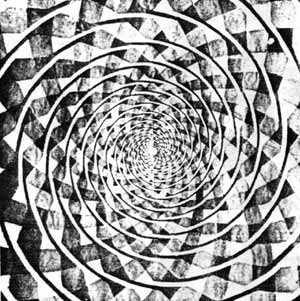
Figure 4. The apparent spiral is in fact concentric circles. This is usually regarded as evidence of visual spatial integration, in this case from misleading line elements.
1.3 Further observations
Dynamic effects occur while either the mortar-line luminance or the luminance of the tiles is varied. The bounding borders of the tiles are seen to move. They creep across the mortar during luminance changes. Though a difficult observation, it seems that the movement is greatest for the borders having the lower boundary contrast with the mortar, as the mortar luminance is varied between the tile luminances. This slight asymmetry of the shifts of the borders is more easily seen when the tiles are displaced a quarter of a cycle, to give a chessboard pattern. It is clear by using colour contrast for the mortar, that this is not merely loss of the mortar when it becomes isoluminant with the dark or light tiles.
It seems to us very important to distinguish between the dynamic shifts with luminance changes and the static displacements observed at constant luminance. They could well be effects or symptoms of different physiological processes, as, for example, static wedge distortion does not increase with mortar luminances not much darker than the dark or much lighter than the light tiles; but this is not so for the dynamic shifts, which are dramatic with extreme changes of mortar contrast. We shall attempt a functional explanation - in terms of processes that seem necessary for maintaining registration of borders. it is hoped that underlying physiological mechanisms may soon be identified, explaining how the functions are mediated.
1.4 Suggested explanation - the border-locking theory
For visual displays such as printing or television, it is technically exceedingly difficult to obtain precise spatial registration at borders, and where contrasting luminances or colours should meet without gaps or overlaps due to misregistration. These border discrepancies are annoying and confusing. Registration may be achieved by high stability of the mechanical or electronic components. but neural components are relatively labile. This problem is exacerbated by the recent finding (Zeki 1976) that visual characteristics such as luminance, colour, and movement are 'mapped' in separate cortical regions. By analogy with the display registration problem it is remarkable that vision is normally free of spurious lines, gaps. or coloured edges at borders where regions of different luminance or colour meet.
Visual registration does, however, seem to be lost in some conditions: (a) with extremely high luminance contrasts, especially at low luminance levels, and (b) for contrasting colours presented with no or very small luminance differences (isoluminance) (Gregory 1977). The former produces discrepancies during image - retina movement, which is hardly surprising, as under conditions of extreme luminosity contrast retinal receptors have very different response times, which must. during image - retinal movement, produce spatial discrepancies of retinally signalled positions. Under the conditions of isoluminant colour contrast. borders appear markedly 'jazzy' (an effect used, if unwittingly, in Op Art) and at isoluminance there is instability and there are relative shifts with movement. So we find similar phenomena for both extreme and zero luminance contrast. Why should this he so? The explanation might be sought in physiological mechanisms; but we shall suggest an explanation in functional terms, without for the moment attempting to specify a mechanism or which neural mechanism may in these conditions be upset or disturbed. It is suggested that spatial registration is normally maintained by an active system accepting border-luminance differences for locking these various features together - so that registration is normally maintained at borders. It seems to us that luminance differences provide master signals for locking, and so registering, contiguous regions of contrasting luminances and colours. We should expect a locking signal system of this kind to break down when: (a) differences in retinal delay are too great for locking to be maintained with image - retina movement; and (b) at isoluminance, when there will be no locking signals to maintain registration. We may also expect systematic distortions to be produced by locking across narrow gaps or lines of neutral luminance. It is to this we attribute the Café Wall illusion. Regions of different luminance separated by a neutral gap, not wider than the range of the locking signals, should be pulled together by the locking normally serving to maintain registration in spite of the lability of neural components, and the different response times associated with different luminances (as demonstrated with the Pulfrich Pendulum; and, for the colour systems, by Benham's disk).
It is suggested that the 'laws' of the Café Wall illusion describe functional properties of the proposed border-locking system. If this is so, the observed distortions and dynamic shifts can be used to demonstrate and measure functional characteristics of the border-locking system; and to discover the limits over which it works appropriately before it allows, or generates, errors appearing as illusory phenomena.
In this study we consider effects of width and luminance of the separating mortar lines; and of contrast and mean luminances of the dark and light tiles. For these measurements, art apparatus was designed and built to vary the luminances and the width of the separating mortar lines over wide ranges, in order to discover the limiting conditions for the distortion to occur and to measure the amount of the distortion under various conditions. The distortions were measured with a simple matching technique.
continues

