
| SECTION 3.2 OF 8 | [1] [2] [3.1] [3.2] [3.3] [4] [5] [6] [7] [Ap] | DOWNLOAD PDF |
R L Gregory and J G Wallace
Reproduced from Experimental Psychology Society Monograph No. 2 1963
(3) Perceptual Tests
One of the difficulties about trying to discover the perceptual world of the blind is that they use the normal words of the sighted, even though they cannot always have the meanings we attach to them. Thus a blind man will say, "I saw in the paper to-day. . ." when he reads it by touch in braille. When S.B. named an object correctly (say a chair or a vase of flowers) we could not discover what special features he used to decide what object it was. It was obvious that facial expressions meant nothing to him, and that he could not recognise people by their faces, though he could immediately do so by their voices, but we could learn little more.
We tried to get some insight into his previous world by getting him to say what surprised him when vision returned. The attempt failed almost completely, as he seldom admitted to any surprises.
We would have liked to obtain accurate measures of such things beloved by the experimental psychologist as the visual Constancies, but this was not practicable, for he tired easily, and we were anxious not to upset either him or the hospital staff. We decided to get him to look at various well-known visual illusions, about which a great deal is known for normal observers, even though explanations for many of them are lacking. The lack of explanation of these illusions did not worry us greatly, for with more knowledge, which is bound to come with further research in perception, they will surely be explained, and then any findings should be relatable to general perceptual issues [ Footnote 10.]. It seemed to us that this would be the best way of getting some reasonably objective information as to his perceptual capacities and peculiarities.
The first three tests to be described here were given on the morning of 26th January 1959, and the remainder on the same afternoon when the first three were repeated.
Test 1. Hering Illusion
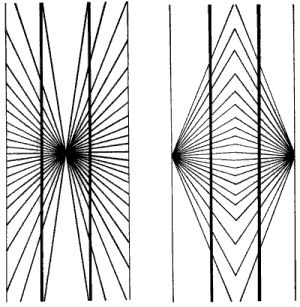
Fig. 1. The Hering Illusion. (a) First form. (b) Second form.
This is shown in Fig. 1a, in which it will be seen that although the heavy vertical lines are in fact straight and parallel, they appear to diverge in the middle. This figure was presented to S.B. printed in heavy black lines on a white card of size 10?" x 4". He held it close to his eye, and studied very carefully in silence.
Result. First he said the lines were straight. He then became doubtful, and thought that they might be further apart at the top and middle. When shown the figures again, in the afternoon, he first said: "One goes out in the middle" and ended by saying that both were straight. We may conclude that the illusion was, if present, considerably less marked than in normal observers. Fig. 1b. gave a similar result.
Test 2. The Zolner Illusion
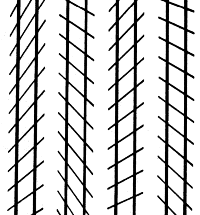
Fig. 2. The Zolner Illusion.
Normally, the verticals look non-parallel and may fluctuate in their positions (Fig. 2).
Result. He reported the verticals, after careful study, as all parallel, and after questioning about variation [jazzing] he said it was "all calm".
Test 3. The Poggendorf Illusion
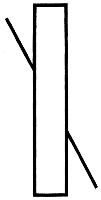
Fig. 3. The Poggendorf Illusion.
Normally, the right-hand section of the slanting line appears to lie below the continuation of the left hand section. (Fig. g).
Result. S.B. reported it as: "all one line".
Test 4. Ambiguous Depth Illusions (reversing figures)
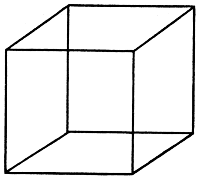
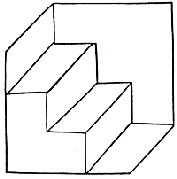
Fig. 4. Ambiguous Depth Illusions. (a) Necker Cube. (b) Staircase Illusion.
(a) The Necker Cube. This also is a very well-known illusion: it was shown as presented in Fig. 4a. It was displayed on a card 10 cm. x 15 cm. the figures being 5.2 cm x 8.0 cm. Normally, this figure is seen to reverse at intervals, the side representing the front being ambiguous.
Result. This gave a most unusual, possibly unique, result. The figure was evidently not seen in depth and it did not reverse.
"We took the greatest possible care to ensure that he understood what we meant by "depth" and "reversal," after he asked us "What is depth?" We did this by showing him (after first obtaining negative answers to our question as to whether it reversed or was seen in depth), a child's wooden brick we had brought along, and pointed out that it receded from him by pointing out the depth with a finger, and getting him to touch it while looking at it. When he looked again at the picture cube he said that he could not see depth, and that, "it looks quite different [from the brick]." He tried, rather unsuccessfully, to draw a cube, but unfortunately this drawing is lost.
(b) The Staircase Illusion. This is similar 'to the Necker cube in that it also is a figure reversible in depth. It was presented on a card. (Fig. 4b).
Result. The result was the same; evidently no depth, and no ambiguity was observed.
Test 5. The Müller - Lyer Illusion
This famous illusion is shown in Fig. 5. When the shafts of the arrows are in fact of equal length, the arrow with diverging fins is seen as longer than that having converging fins. This was presented to S.B. as two arrows end to end, and was so arranged that it could be varied, and continuously adjusted by the observer, who holds the device in his hand. The length of the fixed arrow was 74 cm., and the movable arrow is normally observed to be shorter than this. S.B. adjusted the arrow for apparent equality of length four times, each time with great care.

Fig. 5. Müller - Lyer Illusion.
Result. His estimate of length on the four successive readings were as follows:
| 1. 10.0 | 2. 16.5 | 3. 17.0 | 4. 16.0 |
These figures meaning the under-estimation of length from the standard of 74 cm. His average illusion is thus 14.12 cm, in the normal direction. This may be compared with the mean obtained on ten normal observers on the same apparatus of 20 cm. The extent of the illusion as measured for S.B. is unusually small, though some "normal" observers can be found with a similar degree of illusion.
Test 6. Perspective Size Changes
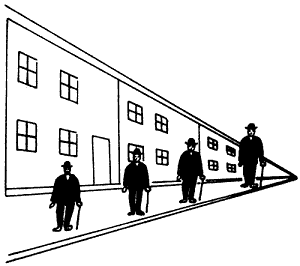
Fig. 6. Perspective Size Illusion.
Figure 6 shows four men, all actually the same size, but normally appearing of increasing size as the apparent distance, due to perspective, increases.
Result. S.B. reported: "They don't look far away, it's just as though the men were standing underneath (? the buildings). The first man looks smaller, but the last three look the same." It should be made clear that these comments were in answer to a request for a description of the relative sizes of the men, and we had to state that the objects depicted were men. As will be seen later he was hardly able to identify drawings of such objects as men.
Test 7. Figure and Ground
One of the classical problems in the study of perception is how "figure" is distinguished from "ground" and whether the distinction is innate or learned. Normally objects stand out against a hardly perceived background, for example the objects in a room against the walls, even when highly decorated, but this can be perceptually ambiguous, as when at dusk the sky is sometimes seen as "object," with the black roofline as unimportant "background". Similarly, looking at a map, the land or the sea can be seen as "object" or "background".
The only example given to S.B. was Fig. 7.

Fig. 7. Figure and Ground Effect.
Result. S.B. made little of it; after some time he said, of the black curved part:
"Is it the case of a fan - a turbine fan?" He meant by this, as questioning elicited, part of the boiler equipment on which he worked. This is particularly interesting, for he had not at that time seen this equipment; he was however certain that he knew what it would look like, from his experience with touch plus his recent visual experience. He gave no response indicating figure - ground fluctuation, and could make nothing of the white part, even when the face" was pointed out in detail.
Test 8. The Ames Distorting Room
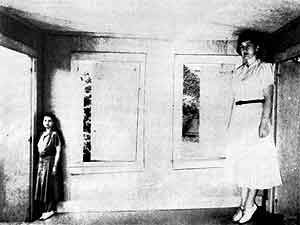
Fig. 8. Apparent Size of Objects in Ames Distorting Room
The Ames distorting rooms are of importance for studies on "visual framework". They emphasise that many judgements of size, shape or distance which may seem to be absolute are relative in the sense that they depend on other features in the visual field.
The rooms are non-rectangular, but are so made that they give, from a chosen viewing position, a retinal image corresponding to a rectangular room. Clearly they must appear rectangular from the chosen position, since no information is available to indicate otherwise, but they become interesting when objects are introduced into the rooms, for objects in fact at different distances may appear to be the same distance from the observer. When this is so, objects of the same size and the same apparent distance will give different sized retinal images. To the normal observer the objects will appear of different sizes even when this is quite contrary to all their past experience. For example, a child can be made to look larger than an adult, as in Fig. 8, which is taken in an Ames room. It would seem that, at least in a Western culture, where most rooms are rectangular, the walls serve as a reference frame for deciding the ever-present perceptual question: is it a large object far away or a small near object giving this size of retinal image?
We should expect S.B. to see an Ames room as rectangular - or at any rate he should not find its shape surprising - but it was an open question what he would see when identical objects were placed in such a room at actually different distances though at apparently the same distance.
To test S.B.'s reactions to this special situation, we used a small model Ames room, into which he looked, using one eye.
Result. He reported the room to be rectangular (in fact the rear wall receded from him to the right), and this result in no way surprised us since the resulting retinal image would be the same as for a truly rectangular room, or box. We then held a half-penny in each of the two windows in the back wall, one window being in fact further from the observer than the other, this distance not being apparent. S.B. reported that the right hand coin looked smaller than the left. When the right hand coin was replaced by a penny piece, and this compared with a half-penny in the left window, he reported that they were of the same size. This response is quite normal for observers using the particular model Ames room we used for this test. We were, rightly or wrongly, considerably surprised by the result.
Test 9. After-Effects of Movement
The well-known after-effect of perceived movement, often called the "waterfall effect" is a marked apparent movement of stationary objects viewed immediately after exposure of the retina to moving stimuli. A familiar example is the apparent movement of the bank of a river when seen after the moving water has been fixated for half a minute or so. The effect may most readily be observed by fixating the centre of a gramophone record while it is rotating, and then stopping the turntable. It will be seen to rotate in the opposite direction, the effect lasting for up to at least twenty seconds.
We tested S.B. for this effect using in place of a simple rotating display, a large spiral mounted on a turntable. Normally after this is viewed rotating slowly, a marked after-expansion or contraction is seen. This is a particularly good display to use because the effect cannot be due to eye movements, since the after-effect is symmetrical round the centre of rotation of the spiral.
Result. First we switched on the motor and asked S.B. to tell us what he saw. He was unable to say, and we discovered that he did not understand or appear to know the words "contract" or "expand". After several exploratory trials we got him to watch carefully for 30 seconds, and to tell us what he saw when the disc was stopped. He reported: "stationary". He appeared to get no after-effect under conditions when a normal observer would experience an expansion lasting 15 - 20 seconds. This was probably not due to lack of acuity, for he did appear to see real movement of the spiral. Language was, however, inadequate for this bizarre situation, and we may have been mistaken in thinking that he obtained no after-effect of any kind, though this appeared to be the case.
Test 10. Rorschach Ink Blots
We showed S.B. cards I and X of the Rorschach test. Our purpose was not to test his personality, but rather to see whether vague and quite unfamiliar shapes would evoke any interesting response.
Result
Card I (no colour). He said: "It is just a design - I can't see what." We asked him: "Does part of it show something?" He answered: "I haven't the slightest idea." Even after the most leading questions he was quite unable to make anything of it.
Card X (coloured). This time he said. "Is this a wallpaper design, or a cushion cover? It looks like a design for something. I can see colours but not what they are - there aren't any flowers are there? I thought it was something of a plant, but there are no flowers, so I thought it was a design." This response is interesting in being one of the few cases where he is evidently thinking aloud. Colour always stimulated him: his greater interest in the coloured card is typical.
Test 11. Kodachrome Projections of Scenery
We showed S.B. several kodachrome transparencies of objects and scenes familiar to sighted people but never seen by him. They were shown by projection.
Slide 1. The Interior of a Cathedral (Hereford). He said: "Is it a building with lights in it? What's all that gold, is it the sun?" (The lighting was in fact rather gold-coloured sunlight). He took a stained glass window to be a door in a church. (This might have been from the common gothic carving to be found in Victorian churches and school doors.) He was rather puzzled by what he thought was a door, and asked: "Why should it have lines down it?"
Slide 2. The Cambridge "Backs" showing River and King's Bridge. He made nothing of this. He did not realize that the scene was of a river, and did not recognise water or bridge. We named the water and the bridge to him, pointing them out.
Slide 3. Evening Scene of Malvern Hills. "This is a landscape is it? I can only tell fields by the colour. What's this gold colour?" He liked the green, but could name nothing on the picture.
Slide 4. The Cambridge "Backs" showing Trinity Bridge. This time he immediately, though with a trace of uncertainty, identified the water as water, and pointing to the double arched bridge said: "Are those bridges again?"
So far as we could tell S.B. had no idea which objects lay in front of or behind other objects in any of the colour pictures. He showed pleasure at green foliage, but could make very little of buildings or other objects. We formed the impression that he saw little more than patches of colour.
Test 12. The Ishihara Colour Vision Test
We gave S.B. the whole of the standard Ishihara Colour Vision Test. That we had brought it along with us turned out to be peculiarly fortunate, for the result was remarkable.
Result. We presented the book of test cards in the normal order, and asked him to try to make out any numbers or letters among the coloured dots. To our extreme surprise he read every single number correctly, as for normal colour vision. That his colour vision would thus appear nearly normal is of secondary importance here, what amazed us was that he was able to make out figures without the aid of any high-contrast outlines. He made only one correction from a 1 to a 7, which is normally found rather difficult to distinguish.
He also succeeded, quite easily, in tracing out the "mazes" on the final test cards, after we showed him what was required using the small paint brush provided as a pointer which does not harm the cards.
It seems very difficult to avoid the inference that he used earlier tactile experience of number shapes. He had never had this or any similar test administered, as we established from the hospital staff.
The fact that he succeeded in reading these numbers is of particular interest as they have no contours, in the ordinary sense, but consist of dots coloured slightly differently from other dots which are of various colours. It would seem impossible for him to have followed outlines with his eyes, since he could not know which colour was relevant until after he had recognised each figure. We noted that he did not attempt to follow the figures with his finger, or make any related movements with his hands or fingers. He read the numbers out quite confidently and quickly, without apparent unusual mental effort. This seems to us the most interesting observation which we made in the study of S.B.
This observation that he was able to read the characters even though masked in the coloured dots of the Ishihara test displays, seems to provide very strong evidence for transfer from earlier tactile experience. This is surprising in view of Riesen's findings that trans-modal transfer does not seem to occur in chimpanzees kept while young in the dark.
continues with Section 3.3 Observations at the infirmary: The Patient’s First Drawings


